
Prosig Signal Processing Blog

Notes, tutorials, news and articles on digital signal capture, processing, techniques and applications

April 14, 2008

WHAT ARE dB, NOISE FLOOR & DYNAMIC RANGE?

By James Wren, Application Engineer, Prosig

TitleMost engineers are probably familiar with or have come across the decibel or dB as a unit of measurement. Its most common use is in the field of acoustics where it is used to quantify sound levels. However, as will be explained in this article, it is also useful for a wide variety of measurements in other fields such as electronics and communications.

One particular use of dB is to quantify the dynamic range and accuracy of an analogue to digital conversion system. This applies to Prosig’s P8000 range of data acquisition hardware where the noise floor, dynamic range and resolution are all specified in terms of dB.   read »»»

March 25, 2008

PROSIG POWER UNITS OFFER NEW LEVELS OF FLEXIBILITY

Prosig Power The size and shape of the Prosig P8000 data acquisition systems greatly facilitates installation in locations that are small or difficult to access. Now Prosig can offer a new level of flexibility. Not only can the P8000 be used in the laboratory and in the automobile, but with the new mobile Prosig Power units they are truly portable. Now with the new Prosig Power units the systems can operate totally independently. The Prosig Power units can be mounted externally or internally and can provide several hours use. As well as improvements to portability the Prosig Power units can be used in situations where power supply from a vehicle is unstable such as during engine cranking.

The P8000 systems are light and easy to carry. They also offer flexible cable connections. The P8000 has a robust design and is capable of operating under extreme temperatures and harsh conditions. The low power consumption and low heat generation of the P8000 gives its advanced cooling system the flexibility to completely shut off the system fans during data captures thus providing absolute silence for acoustic measurements.

Filed under: news

March 4, 2008

VIBRATION MONITORING PHASE MEASUREMENT AND THE TACHO SIGNAL

By Dr Colin Mercer, Technical Director, Prosig

Any vibration signal may be analyzed into amplitude and phase as a function of frequency. The phase represents fifty percent of the information so it is most important to measure phase for vibration monitoring. Most vibrations on a rotating machine are related to the rotational speed so it is clearly important to have a measure of the speed, either directly or as a once per revolution tacho pulse. A question some time arises as to whether a once per revolution tacho reference signal is needed to measure phase. Is it possible to get phase if we only have a speed signal? This note gives some insight into those questions. Actually the question that should be asked is - “Can we measure a meaningful phase, for use in vibration monitoring, if we only have a speed signal as well as the vibration signals?” read »»»

November 30, 2007

HUMAN EXPOSURE TO VIBRATION IN BUILDINGS (DIN 4150-2:1999-06 & DIN 45669-1:1995-06)

By Dr Colin Mercer, Technical Director, Prosig

Standards DIN 4150-2:1999-06 and DIN 45669-1:1995-06 provide a means of assessing the effect on human beings of vibration caused by vehicle traffic, trains both above and below ground, construction work and occasional impulsive type vibration caused by, say, blasting and the like.

DIN 45669-1 describes the signal processing actions and DIN 4150-2 details how these are used. Provisions are included for day or night levels and for five categories of building:

  • Industrial
  • Predominantly Commercial
  • Mixed Commercial and Residential
  • Residential
  • Special Areas such as Hospitals

read »»»

October 23, 2007

ORDERS V TIME - COMPARING OVERALL LEVELS

By Dr Colin Mercer, Technical Director, Prosig

By combining a speed signal with a data signal and using the Short Time FFT algorithm (Hopping FFT), it is possible to extract order data directly as a function of time (Orders from Hopping FFT) rather than as a function of speed (Waterfall). This is very useful when analyzing a complete operational cycle which includes run ups, rundowns and periods at operational speeds. read »»»

October 5, 2007

CALCULATING VELOCITY OR DISPLACEMENT FROM ACCELERATION TIME HISTORIES

By Adrian Lincoln, Technical Director, Prosig

Velocity or displacement from accelerationIt is quite straightforward to apply “classical” integration techniques to calculate either a velocity time history from an acceleration time history or the corresponding displacement time history from a velocity time history.

The standard method is to calculate the area under the curve of the appropriate trace. If the curve follows a known deterministic function then a numerically exact solution can be found; if it follows a non-deterministic function then an approximate solution can be found by using numerical integration techniques such as rectangular or trapezoidal integration. Measured or digitized data falls in to the latter category. However, if the data contains even a small amount of low frequency or DC offset components then these can often lead to misleading (although numerically correct) results. The problem is not caused by loss of information inherent in the digitisation process; neither is it due to the effects of amplitude or time quantisation; it is in fact a characteristic of integrated trigonometric functions that their amplitudes increase with decreasing frequency. read »»»

September 12, 2007

SOUND STEERING

By Richard O’Sullivan, Quiet! Acoustic and Vibration Consulting

Steering pumpsThe requirement was to develop a ‘standard’ test for assessing the sound quality of power steering pumps in vehicles. Measurements needed to be objective so that the method would be suitable for evaluating dissimilar vehicles and different types of pump.

Noise is an important consideration when a consumer is selecting a new vehicle. It is therefore imperative that every aspect of the vehicle’s acoustic profile is thoroughly understood and refined.

From an end user point of view the assessment criterion is simply how much will the driver or passengers hear the pump noise in relation to the vehicle background noise. That is, will the pump produce, what may be called, audible tones with the vehicle in different operating conditions. read »»»

June 24, 2007

MEASURING TORSIONAL CRANK SHAFT JITTER

By Mike E Moore, VP Sales & Marketing, Prosig USA, Inc.

Using Prosig’s P8000 series data acquisition system with DATS signal analysis software, torsional analysis (crank jitter) was performed on an automotive engine attached to an engine dynamometer. The significance of this is that only one tachometer channel was required to identify crank jitter. read »»»

May 23, 2007

WHAT IS RESONANCE?

By James Wren, Application Engineer, Prosig

ResonanceFirst, in order to explain resonance we have to explain the terms we will use.
• A resonance is a particular frequency.
• A period is the amount of time it takes to complete one cycle
• The number of cycles in one second is the frequency of an oscillation.
• Frequency is measured in Hertz, named after the 19th-century German physicist Heinrich Rudolf Hertz
• A single Hertz is equal to one cycle per second.
read »»»

April 7, 2007

PROSIG / SENSOUND ALLIANCE

SensoundProsig USA Inc. is proud to announce an alliance with SenSound, maker of powerful 3D acoustic holography software. To kick off the new Prosig / SenSound alliance a demo day has been scheduled to give engineers a thorough understanding of the potential available in acoustic testing. The demo will be at TechTown, in Detroit, MI, USA on April 11th 2007. Attendance is limited. Don’t be disappointed. Contact Mike Moore to book your place. If you can’t make the demo day, but would like further information of the Prosig/Sensound system or any of Prosig’s other products please contact sales@prosig.com. read »»»

Filed under: news

March 29, 2007

EVALUATING A CLOSED LOOP CONTROL SYSTEM FOR HIGH PRESSURE PUMPS

By James Wren, Application Engineer, Prosig

Prosig were recently involved in the validation of a closed loop control system for an automotive pump supplier. The customer has a large number of test cells, each test cell has 8 pumps continually on test. Each pump is instrumented with a revolution or tachometer sensor, giving a once per revolution tachometer pulse. Additionally, there are various analogue transducers on each pump which measure parameters, such as pressure at the pump inlet and outlet. read »»»

February 25, 2007

ORDER CUTS AND OVERALL LEVEL

By Dr Colin Mercer, Technical Director, Prosig

Order cuts are taken from a set of FFTs, each one at a different rpm. The rms level is then found as the Square root of the Sum of the squares of each of the FFT values. Mathematically, if Xks is the modulus (magnitude) of the kth value of the FFT at speed s for k = 1…N-1 then the rms value at that speed is given by
rms formula
This takes into account the entire energy at that speed both the order and the non order components, including any noise. read »»»

December 7, 2006

ACCELERATION, VELOCITY & DISPLACEMENT SPECTRA – OMEGA ARITHMETIC

By Dr Colin Mercer, Technical Director, Prosig

Accelerometers are robust, simple to use and readily available transducers. Measuring velocity and displacement directly is not simple. In a laboratory test rig we could use one of the modern potentiometer or LVDT transducers to measure absolute displacement directly as static reference points are available. But on a moving vehicle this is not possible.

More here… OmegaArithmetic.pdf

November 9, 2006

EXAMPLES OF EVENT EXTRACTION AND REMOVAL

By Dr Colin Mercer, Technical Director, Prosig

Event ExtractionIn many cases only significant events, such as bumps or other transients in a signal are of relevance. The objective is to be able to isolate these events in a meaningful manner so that they may be automatically recognised and either removed or extracted for analysis in a structured way.
There are two principle objectives initially: one is to be able to recognise an event and the other is to be able to mark it in some way so that subsequent software is able to operate on the actual event. We must also note that an event has a start and an end; the criterion we use to recognise the start may not necessarily be the same criterion we use to recognise the end. Searches for the start and end points are carried out on a Reference Signal. How the reference signal is formed is discussed in detail later, it includes the original signal, various running statistical measures such as the dynamic RMS, differentiation for slope detection, integration and so on. In many cases the start criterion will be some check on the level achieved by the reference signal. By the time any check level has been detected then it is almost certain that the event started earlier! That is, a pre trigger capability is essential. read »»»

October 3, 2006

UPDATED PROTOR SYSTEM FOR RINGHALS, SWEDEN

RinghalsProsig installed a PROTOR system at the Ringhals1 reactor in Sweden in 1992. This system was based on the PROTOR2 level of hardware and software and consisted of a Sun workstation and PC based acquisition system. The system has been successfully monitoring the two main turbine generators ever since. Last month Prosig upgraded this system to their latest PROTOR4 hardware and software.

The system now consists of a high-end rack-mount server PC containing RAID, hot-swap disks, dual high-speed Ethernet LANs and redundant power supplies together with two 32-channel 4700 data acquisition units.

The system is connected into the station alarm system so that control room staff are automatically alerted on vibration alarms. The system is fully integrated within the Ringhals network for data archiving, remote access and data transfer with the plant computer.

read »»»

September 11, 2006

MEASURING FOR SUCCESS

By James Wren, Application Engineer, Prosig

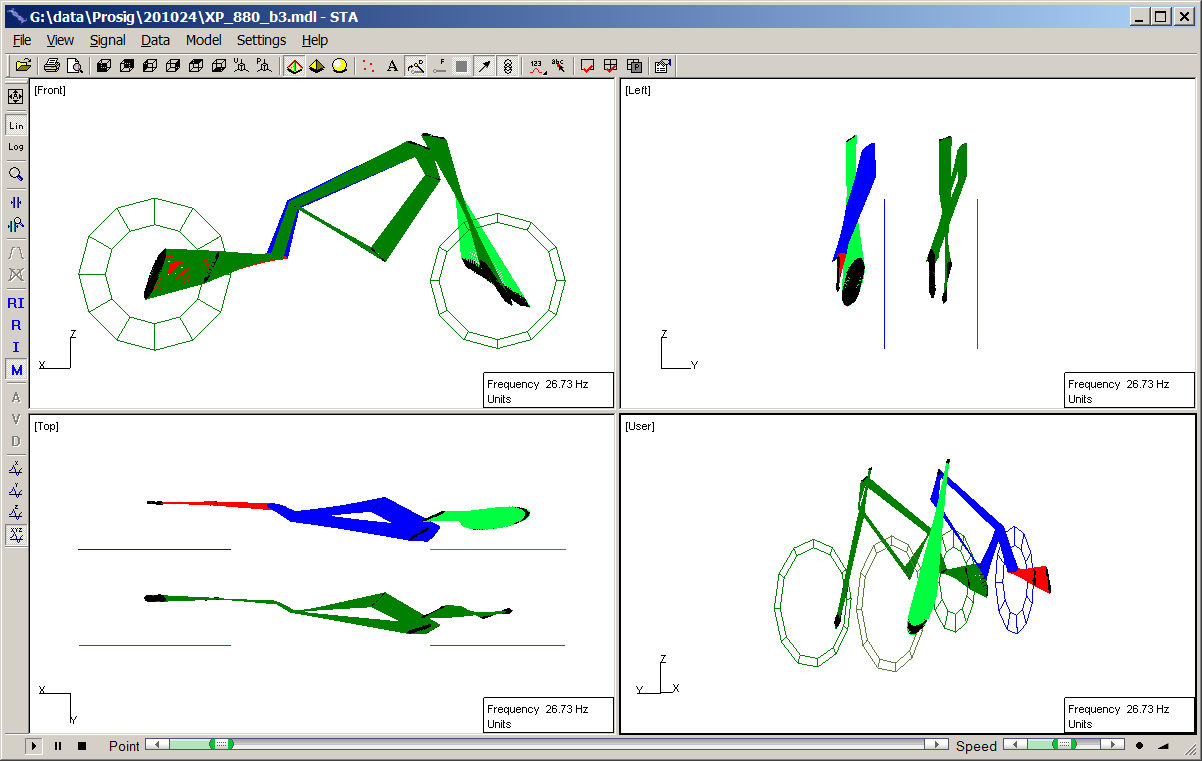
The following application note shows the steps taken to perform a structural analysis on an automotive exhaust pipe structure with the aim of improving the structural damping properties of the exhaust pipe mount. This application note is a follow up to a previous article – “Preventing Component Failure In The Fast Lane”.

A recent signal processing application note described how the Prosig sponsored Dalmeny Racing Formula Ford Team, whilst contesting the UK Formula Ford 1600cc championship, suffered several minor structural failures on a particular part of an exhaust pipe mount. Prosig dispatched a team of engineers and after a brief survey of the damage the Prosig engineers made an outline assessment “Our initial thoughts are that the exhaust itself might be resonating at particular engine speeds, thus causing some shear forces in the mount, which could then in turn cause stresses in the material leading to cracking and eventually failure.” read »»»

June 6, 2006

MADE TO MEASURE

By James Wren, Application Engineer, Prosig

Made to MeasureIn this note the different types of transducers that can be used with the Prosig P8000 series data acquisition system are discussed. The article deals with the design and function of the different types of transducer and the applications they are normally associated with. read »»»

May 17, 2006

FATIGUE & DURABILITY TESTING

By James Wren, Application Engineer, Prosig

The following application note describes the test and measurement process for the fatigue testing and development cycle of a component. Strain gauges were used to monitor the strain levels in a particular suspension component. The component had been known to fail at various intervals. A predicted life for the component was required to analyse the feasibility of the its continued use or to see if a design change was required. The component under test (Figure 1) was an automotive suspension component, specifically a tie rod. The testing was carried out by a major automotive manufacturer. read »»»

February 20, 2006

EXHAUST DEVELOPMENT USING A PROSIG P8000 SYSTEM

By James Wren, Application Engineer, Prosig

The following note describes an application of the Prosig P8000/DATS system in the refinement of an automotive exhaust muffler design for a major after-market exhaust manufacturer in Europe. The particular vehicle under test was required by local legislation to have an overall radiated noise level of less than 70 dB. When tested, the vehicle was found to be producing 71.8 dB of radiated noise. The design of the exhaust system clearly needed to be reviewed and modified. read »»»

February 17, 2006

“STANDARD” OCTAVE BANDS

By Dr Colin Mercer, Technical Director, Prosig
The “standard” centre frequencies for 1/3 Octaves are based upon the Preferred Numbers. These date from around 1965. They are not specific to third octaves. The only reference we have is to British Standard BS2045:1965 Preferred Numbers. There are probably equivalent ISO and ANSI versions. read »»»

January 12, 2006

TORSIONAL VIBRATION, TACHO PULSES AND ALIASING

By Dr Colin Mercer, Technical Director, Prosig

With shafts, gears and the like, the general method of determining the rotational speed is to use some form of tachometer or shaft encoder. These give out a pulse at regular angular intervals. It we have N pulses per rev then obviously we have a pulse every (360/N) degrees. Determining the speed is nominally very simple: just measure the time between successive pulses. If this period is Tk seconds and the angle travelled is (360/ N) degrees then the rotational speed is simply estimated by 360/(N*Tk) degrees/second or 60/(N*Tk) rpm. read »»»

October 19, 2005

ANALYZING SHAFT TWIST AND REPAIRING DAMAGED TACHOS

By Dr Colin Mercer, Technical Director, Prosig

A shaft has been instrumented with two shaft encoders, one at each end. Each shaft encoder gives out a once/rev pulse and a 720 pulses/rev signal. Each signal was digitised at 500,000 samples/second. The objective is to measure the twist in the shaft and analyze into orders. The test stand was already equipped with a data acquisition system so a Prosig acquisition system was not required. Instead it was decided that the data captured by the resident system would be imported into the DATS software. The only format available from the customer system was ‘comma separated variables’ or CSV. This is not ideal as it is an ASCII based format and therefore creates very large files. read »»»

August 26, 2005

A SIMPLE NOISE TEST

In a recent article we described how the Prosig P8000 hardware and DATS software had been used to help Dalmeny Racing diagnose a problem with an exhaust bracket on their Formula Ford racing car. Whilst the car was instrumented for structural tests on the exhaust the opportunity was taken to also take some noise and vibration readings during an engine run up. It was felt that these would provide some useful “real world” data as well as maybe providing some extra information regarding the exhaust bracket failure. After analysing and animating the hammer data it became clear that the engine runup data wouldn’t be needed. However, it was decided that some analysis should be carried out to see if the noise and vibration data backed up the conclusions of the other tests. read »»»

August 9, 2005

PHASE BETWEEN SIGNALS

By Dr Colin Mercer, Technical Director, Prosig

The following article was written in response to a question from a visitor to the website. The gentleman in question had been reading some of the Prosig signal processing articles and had the following question.

Dear Sir,

It was interesting reading the articles in your mail.I would like
to know the options available in hardware and/or software for measurement/calculation
of phase angle of first harmonic of a vibration signal which is
sinosoidal. The phase angle is the relative phase angle difference
between the signal and the tacho - one into rpm signal.

Regards.
etc.

read »»»

June 14, 2005

AVERAGE WATERFALLS OR AVERAGE ORDERS?

By Dr Colin Mercer, Technical Director, Prosig

One would expect that averaging waterfalls and then extracting orders would give the same result as extracting orders from individual waterfalls and then averaging them. This is not the case. read »»»

Older Posts »

Powered by WordPress