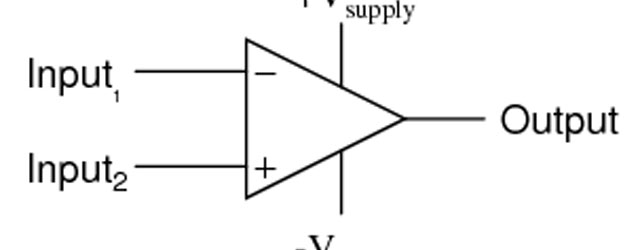
What Is The Difference Between Single Ended & Differential Inputs?
Prosig data acquisition systems use differential inputs, but what are they and why are they so special? This subject is not always fully understood and, therefore, the focus of this…

Prosig data acquisition systems use differential inputs, but what are they and why are they so special? This subject is not always fully understood and, therefore, the focus of this…
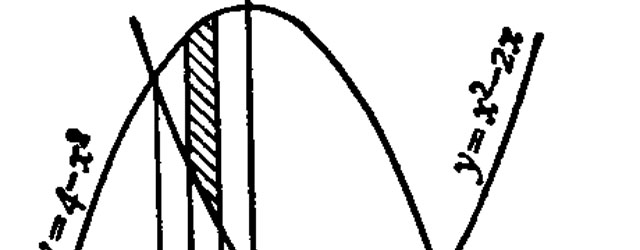
From time to time I meet engineers who are interested in the conversions between acceleration, velocity and displacement. Often, they have measured acceleration, but are interested in displacement or vice versa. Equally, velocity is often used to find acceleration. This article outlines the nature of the conversion between these units and will suggest the preferred method for doing so. .

Nowadays it is easy to attach extra screens to most computers. It is not uncommon to have a two or even three monitor setups. Even with laptops it is fairly easy to attach either a full size extra monitor or maybe a small screen via USB. To make full use of this extra screen ‘real estate’ one needs software applications that allow parts of the interface to be moved into separate windows. This process is often known as ‘floating’. The following article outlines how to use floating tabs in DATS Acquisition. This feature has always been important in automotive testing, but is now becoming more useful in other applications.
 Sometimes we are asked about the differences between an acoustic camera and a sound intensity probe and which of the two is better for a particular application. There is no straightforward answer as they are quite different pieces of equipment, used for measuring different things. An acoustic camera is a tool used to locate and analyse sound sources, usually both steadystate and dynamic phenomena. The intensity probe is used to find the sound intensity at a particular position, usually a steadystate phenomena.
We're often asked what is the difference between microphone types; free field, diffuse field and pressure. For a run-of-the-mill ½ inch microphone the short answer is nothing. However the long…

The following article will attempt to explain the basic theory of the frequency response function (FRF). This basic theory will then be used to calculate the frequency response function between two points on a structure using an accelerometer to measure the response and a force gauge hammer to measure the excitation.
Fundamentally a FRF is a mathematical representation of the relationship between the input and the output of a system.
(more…)
A strain gauge is an electrical sensor which is used to accurately measure strain in a test piece. Strain gauges are usually based on a metallic foil pattern. The gauge is attached to the test piece with a special adhesive. As the test piece is deformed, so the adhesive deforms equally and thus the strain gauge deforms at the same rate and amount as the test piece. It’s for this reason that the adhesive must be carefully chosen. If the adhesive cracks or becomes detached from the test piece any test results will be useless.
Strain gauges are used not just for metals; they have been connected to the retina of the human eye, insects, plastics, concrete and indeed any material where strain is under investigation. Modern composite materials like carbon fibre when under development are often constructed with strain gauges between the layers of the material.
The size and shape of the Prosig P8000 data acquisition systems greatly facilitates installation in locations that are small or difficult to access. Now Prosig can offer a new level…

We hear the word used a lot, but what is resonance? First, in order to explain we have to explain the terms we will use.

Prosig were recently involved in the validation of a closed loop control system for an automotive pump supplier. The customer has a large number of test cells, each test cell has 8 pumps continually on test. Each pump is instrumented with a revolution or tachometer sensor, giving a once per revolution tachometer pulse. Additionally, there are various analogue transducers on each pump which measure parameters, such as pressure at the pump inlet and outlet.

The following application note shows the steps taken to perform structural analysis using a hammer impact test on an automotive exhaust pipe structure to improve the structural damping properties of the exhaust pipe mount. This application note follows up to a previous article – “Preventing Component Failure In The Fast Lane”.
A recent signal processing application note described how the Prosig sponsored Dalmeny Racing Formula Ford Team, whilst contesting the UK Formula Ford 1600cc championship, suffered several minor structural failures on a particular part of an exhaust pipe mount. Prosig dispatched a team of engineers, and after a brief survey of the damage, the engineers made an outline assessment. They concluded that “the exhaust itself is resonating at particular engine speeds. This is causing some shear forces in the mount. This in turn is causing stresses in the material leading to cracking and eventually failure.”
(more…)
[Updated 4th October 2021]
In this post, we will discuss the different types of transducers that can be used with the Prosig data acquisition systems and loggers. The post looks at the design and function of the different types of sensors and the applications they are normally associated with.
(more…)
The following application note describes the test and measurement process for the fatigue & durability testing and development cycle of an automotive suspension component, specifically a tie rod. The component had been known to fail at various intervals. An estimate of the predicted fatigue life of the component was required in order to assess the feasibility of its continued use and to see if a design change was required. The component under test is shown in Figure 1. The testing was carried out by a major automotive manufacturer. Strain gauges were used to monitor the strain levels.

The following note describes measuring exhaust noise using a Prosig P8000/DATS system for the refinement of an automotive muffler design for a major after-market exhaust manufacturer in Europe. The particular vehicle under test was required by local legislation to have an overall radiated noise level of less than 70 dB. When tested, the vehicle was found to be producing 71.8 dB of radiated noise. The design of the exhaust system clearly needed to be reviewed and modified. (more…)
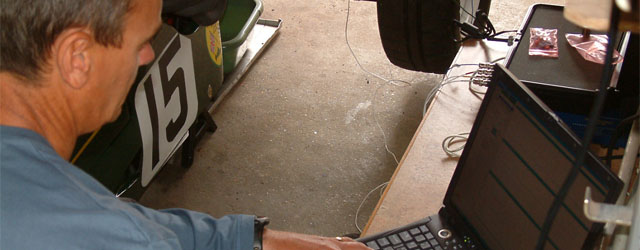
In a recent article we described how the Prosig P8000 hardware and DATS software had been used to help Dalmeny Racing diagnose a problem with an exhaust bracket on their Formula Ford racing car. Whilst the car was instrumented for structural tests on the exhaust the opportunity was taken to carry out a simple automotive noise test. It was felt that these would provide some useful “real world” data as well as maybe providing some extra information regarding the exhaust bracket failure. After analysing and animating the hammer data it became clear that the engine runup data wouldn’t be needed. However, it was decided that some analysis should be carried out to see if the noise and vibration data backed up the conclusions of the other tests.