What Are dB, Noise Floor & Dynamic Range?
We are often asked what noise floor & dynamic range actually are. Most engineers are probably familiar with or have come across the decibel or dB as a unit of…

We are often asked what noise floor & dynamic range actually are. Most engineers are probably familiar with or have come across the decibel or dB as a unit of…

Sometimes it doesn't hurt to revisit some of the basic building blocks that form the foundation of what we do. And so we have gathered together a few of our…

There are many reasons to measure and analyze noise. It may relate to legislation or regulations that limit noise in certain environments, we could be using the noise to investigate…

When one thinks of noise in a signal, it is generally associated with having been added in some way to the amplitude of a signal. This is not always the…
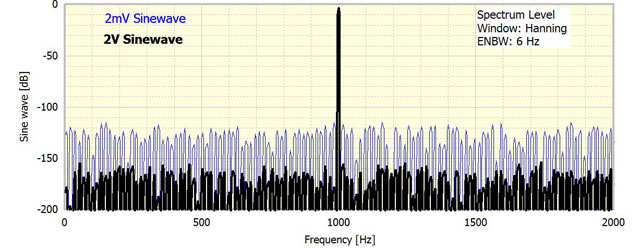
At least one manufacturer of data acquisition systems claims to achieve an incredibly high dynamic range (160dB) when capturing data. This is supposedly achieved by the use of dual-range data acquisition architecture. Such systems have two analog-to-digital convertors for each input channel; one of the ADCs captures the full voltage range of the input signal and the other ADC captures the input signal only when it is small. This article explains the facts behind the figures and shows that the use of Dynamic Range as a measure of precision can be misleading.

In many real-world applications it is impossible to avoid “spikes” or “dropouts” in data that we record. Many people assume that these only cause problems with their data if they become obvious. This is not always the case. Consider the following two time histories.