Developing an Algorithm for Tick Detection

An investigation was made of a sample of automotive components where some were exhibiting a high frequency “tick” or rattle during each operating cycle. This feature could be heard above the normal operating noise. The problem this posed was to measure and analyze components in an objective fashion and classify components as “good” or “bad”.

(more…)

Continue ReadingDeveloping an Algorithm for Tick Detection
Read more about the article Amplitude And Energy Correction – A Brief Summary
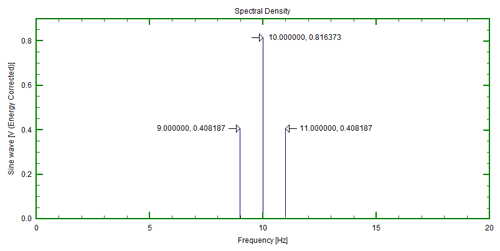
Figure 4: Energy corrected spectrum

Amplitude And Energy Correction – A Brief Summary

Amplitude and energy correction has been and is a continuing point of confusion for many people calculating spectra from time domain signals using Fourier transform methods. The first thing to say, the information contained in data presented as amplitude and energy corrected spectra is equivalent. The only difference is the scaling of the numbers calculated.

(more…)

Continue ReadingAmplitude And Energy Correction – A Brief Summary

Orders v Time – Comparing Overall Levels

By combining a speed signal with a data signal and using the Short Time FFT algorithm (Hopping FFT), it is possible to extract order data directly as a function of time (Orders from Hopping FFT) rather than as a function of speed (Waterfall). This is very useful when analyzing a complete operational cycle which includes run ups, rundowns and periods at operational speeds.

(more…)

Continue ReadingOrders v Time – Comparing Overall Levels

Order Cuts And Overall Level

Order cuts are taken from a set of FFTs, each one at a different rpm. The rms level is then found as the Square root of the Sum of the squares of each of the FFT values. Mathematically, if x_{ks} is the modulus (magnitude) of the k^{th} value of the FFT at speed s for k = 1,\dots,N-1 then the rms value at that speed is given by

rms_s = \sqrt{\sum_{k=0}^{N-1}{x_{ks} ^2}}

This takes into account the entire energy at that speed both the order and the non order components, including any noise.

(more…)

Continue ReadingOrder Cuts And Overall Level

Examples Of Event Extraction And Removal

Event ExtractionIn many cases only significant events, such as bumps or other transients in a signal are of relevance. The objective is to be able to isolate these events in a meaningful manner so that they may be automatically recognised and either removed or extracted for analysis in a structured way.

There are two principle objectives initially: one is to be able to recognise an event and the other is to be able to mark it in some way so that subsequent software is able to operate on the actual event. We must also note that an event has a start and an end; the criterion we use to recognise the start may not necessarily be the same criterion we use to recognise the end. Searches for the start and end points are carried out on a Reference Signal. How the reference signal is formed is discussed in detail later, it includes the original signal, various running statistical measures such as the dynamic RMS, differentiation for slope detection, integration and so on. In many cases the start criterion will be some check on the level achieved by the reference signal. By the time any check level has been detected then it is almost certain that the event started earlier! That is, a pre trigger capability is essential.

(more…)

Continue ReadingExamples Of Event Extraction And Removal

Dynamic Range And Overall Level : What Are They ?

Accurate measurement of a signal depends on the dynamic range and the overall level of the data acquisition system. The overall level setting may be thought of as determining the largest signal that can be measured. This clearly depends on the present gain setting. That is the overall level is related to the gain. Clearly if the overall level is too small (gain too high) then the signal will be clipped and we will have poor quality data. The dynamic range then tells us that for the given overall level what is the smallest signal we can measure accurately whilst simultaneously measuring the large signal.

In a very simple sense suppose we have an artificial signal which consists of a sinewave at a large amplitude A for the first half and that this is followed by a sinewave with a small amplitude a for the second half. We will set the gain (the overall level) to allow the best measurement of the A sinewave. The dynamic range tells us how small a may be so we can also measure that without changing settings.
(more…)

Continue ReadingDynamic Range And Overall Level : What Are They ?

Does The Signal Have A Gaussian Probability Density?

The PROB module in DATS for Windows provides, amongst other options, a probability density analysis. Also, the signal generation suite has a module, GENPRB, which generates a classical gaussian probability density curve (and others). How then may these be used to compare the probability density of our measured signal with that of a true Gaussian one. The method is quite straight forward and is a matter of scaling.

(more…)

Continue ReadingDoes The Signal Have A Gaussian Probability Density?

Time Varying Overall Level Vibration (or Noise)

A common requirement to measure overall level vibration (or noise) as a function of time. Now, the overall level is a measure of the total dynamic energy in the signal. That is it does not contain the energy due to the DC level, which is the same as the mean value. The overall level is often loosely referred to as the signal RMS value. However the formal definition of the RMS level is that it contains the DC level as well as the dynamic energy level. If only the dynamic contribution is required then the measure needed is, strictly speaking, the Standard Deviation (SD). Sometimes it is useful to refer to the SD as the Dynamic RMS.

(more…)

Continue ReadingTime Varying Overall Level Vibration (or Noise)