Quantifying Signals – Peak, Peak-to-Peak, & RMS metrics
Anytime you measure something which is changing with time, there are multiple ways to quantify the signal. For the purpose of this discussion, we will be talking about how to describe the…

Anytime you measure something which is changing with time, there are multiple ways to quantify the signal. For the purpose of this discussion, we will be talking about how to describe the…
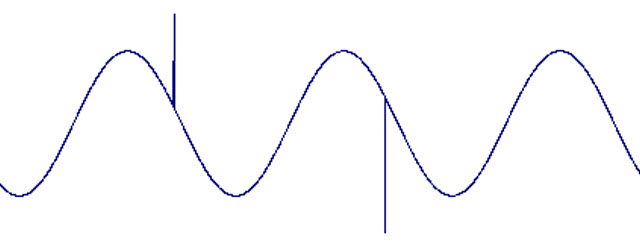
Whether you call them spikes, glitches, anomalies or data dropouts, these phenomena have been a problem to engineers ever since they started recording data. There are any number of reasons…
A DATS user asked…
We are using the third octave band filter at very low frequencies (~1Hz) and I noticed that the response of the filter could introduce very significant errors for short or transient signals. Looking a bit more in details at the function, the help says:
“For audio work ISO standards use a reference frequency of 1kHz not 1Hz”
Does that implies that for non-audio work, a reference frequency of 1Hz should be applied? If yes, is it possible to change this reference frequency in the dats function?
Dr Mercer replied…
Essentially there is no problem and no need to change the reference frequency provided you use Base 10 mode and not Base 2. Base 10 is the ANSI S1.11-2004 preferred scheme. (more…)

We are often asked about AC and DC coupling. This is important to understand when working in the signal processing field. In terms of AC and DC Coupling, what is…

There are many reasons to measure and analyze noise. It may relate to legislation or regulations that limit noise in certain environments, we could be using the noise to investigate…

This article is a follow on from What Is Resonance? (Part 1) and answers some of the issues not covered in that post. How do you find the resonant frequency…
This article addresses two basic approaches to analyzing rotating machinery during transient (sweeping rpm) conditions. The first is the traditional method which uses Frequency (FFT) Spectrum analysis at target rpm…
A simple question should have a simple answer and that answer is “No”.
As usual, however, life is never that simple. (more…)
How do you measure the causes of a noise or vibration with respect to several sources? Which source is causing what part of the response?
For example, how does the noise inside the cabin of a vehicle relate to the engine noise or wheel hub noise and vibration? (more…)
ODS = Motion of structure vibrating naturally (for example bridge vibration) or when excited by an unknown force (for example generator vibration). Prosig’s Structural Animation software performs ODS analysis.
OMA = Modal Analysis
Prosig’s Modal Analysis software performs OMA. (more…)
Transfer Path Analysis (TPA) provides the route of the noise or vibration through the structure, not just which sources cause the response, but the route taken. This is useful for developing and improving components like engine anti-vibration mountings or suspension anti-vibration mountings. (more…)

For some time now it has been conventional ‘wisdom’ that using time based digital integration may cause amplitude errors in the result and that these get worse as the frequency increases. As a result of this, integration using Omega arithmetic has been prevalent by using Fourier Transforms of the signal. This, of course, remains a valid approach and is particularly useful if the data is already in the frequency domain, which was its prime purpose.
Generally. when developing and testing bearings a simple step by step procedure should be followed.


When one thinks of noise in a signal, it is generally associated with having been added in some way to the amplitude of a signal. This is not always the…

When measuring noise and vibration in rotating machines, especially complex devices like automobile engines, it is very important to fully understand what is being measured and what analyses need to…

When monitoring vibration on large gas or steam turbines and generators with fluid-film bearings, the relative movement of the shaft within the bearing is typically measured by a pair of…
We're going to look today at some of the practical aspects of how we measure noise & vibration and consider why it's important that you should measure and, more importantly,…

This seemingly simple question is actually quite fundamental. To answer the question we need to consider sound intensity. Now sound intensity is defined as “the average rate of flow of…

Are you interested in measuring torsional vibration? Need to measure shaft twist? Worried about rotational jitter? Don't worry, we've got it covered. Here we have gathered together our most popular…
When we are dealing with multiple measurements we often need to calculate a resultant vector to understand their combined effect. What do we mean by this? And how do we…

Normally when we are analysing a signal it is a purely real signal, that is it has no imaginary part. A classic example is of course a sine wave. When…

The term synchronous data is usually applied to vibration or acoustic data that is captured from an item of rotating equipment at regularly spaced angle intervals as distinct from regularly spaced time intervals. The rotating part could be an engine, a gear wheel, a drive shaft, a turbine rotor, a propeller, a turbocharger or any other type of rotary mechanical device. Typically these items are subjected to out-of-balance forces that cause them to vibrate at frequencies that are multiples of the fundamental (once per revolution) rotation speed frequency. (more…)
This is complete version of the video illustrating my recent article How To Measure Noise & Vibration In Rotating Machines. This video was previously published on the blog in 3 parts.…

Recently when discussing with an engineering student the characteristics of filters, it became clear that some confusion exists around this subject area. This note attempts to explain the differences between types of filter and the effects of the parameters of those filters. (more…)

This is the complete version of the video illustrating my recent article How To Measure Noise & Vibration In Rotating Machines. This video was previously published on the blog in 3…